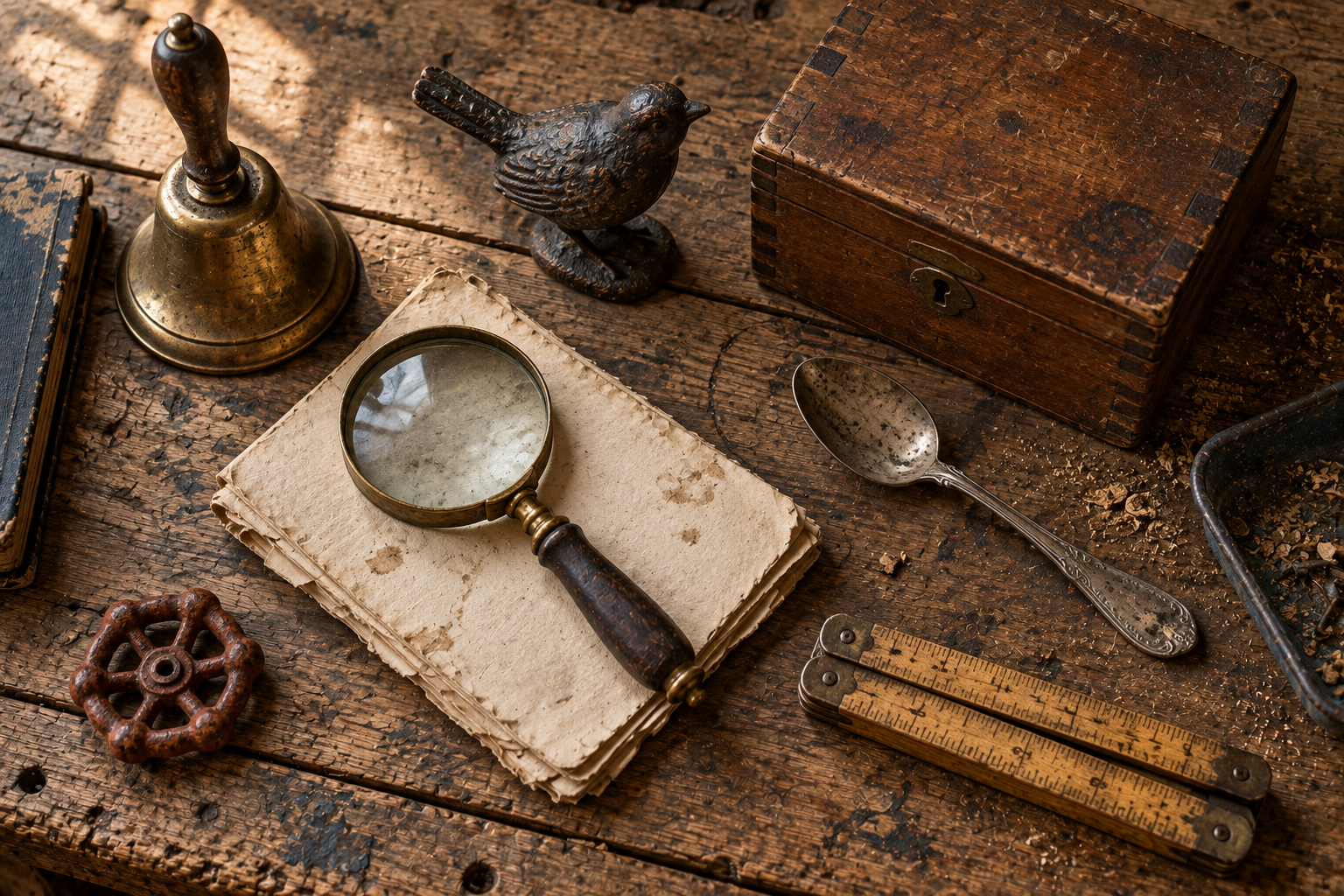
A lot of old things are interesting. Fewer are worth loading into the truck. The trick is telling the difference before the dust settles and somebody asks whether that dent is supposed to be there.
We look for pieces that still have a job to do, even if that job has changed. A shop bell can become a desk bell. A wooden box that once kept receipts can keep photographs. A brass dog can crack walnuts or simply sit there looking more dignified than everyone else in the room. Useful is good. Useful with personality is better.
Start with how it was made
Construction usually speaks before a label does. We look at joints, fasteners, hinges, casting marks, tool marks, and the places a maker never expected anyone to inspect. A drawer joined with dovetails tells a different story than one held together with staples. An old screw, a hand fitted lid, or the rough back of a cast figure can say more than a shiny paper tag.
That does not mean every handmade piece is valuable or every machine made piece should stay behind. It means the object should make sense as a whole. Materials, construction, and wear ought to agree with one another. When they do not, we slow down and have another look.
- Check the joints and fasteners before trusting a label.
- Compare the wear on the top, bottom, handles, and edges.
- Look for materials and construction that tell the same story.
Wear should show where life happened
Honest wear has a pattern. Handles soften where hands grabbed them. Box corners round off. Brass darkens in recesses and stays brighter on raised edges. A bell shows use around the clapper. These details are not damage by default. They are the receipt for a life already lived.
Artificial age tends to be evenly enthusiastic. Every corner is rubbed, every surface is distressed, and somehow the bottom looks as theatrical as the top. Real use is less organized. It leaves fingerprints, not stage directions.
A repair can be part of the story
Old repairs do not automatically send a piece back to the table. A careful patch, a replaced hinge, or a small solder line can show that somebody thought the object was worth keeping. We care more about whether the repair is stable, understandable, and fairly represented.
There is a difference between a scar and a structural problem. A scar adds history. A structural problem adds a future afternoon with glue, clamps, and language unsuitable for the listing description. We price accordingly.
Useful beats merely old
Age alone is not a business plan. We ask whether a piece can live comfortably in a house now. Can it hold something, light something, organize something, ring, open, close, or make a blank shelf considerably less boring? The answer does not need to be practical in the strictest sense. Happiness counts as a function around here.
Scale matters too. A small box, lamp, tray, or figure can fit into a home without requiring a moving crew or a discussion with the homeowners association. When a larger piece earns its space, it needs enough presence to justify the floorboards.
Leave room for the odd one
The best find in a group is sometimes the one that takes a minute. Maybe the shape is unusual. Maybe the purpose is not obvious. Maybe it is a brass animal doing a job no animal was ever hired to do. Those pieces make a room feel collected instead of ordered from a catalog in one determined afternoon.
We do not need every object to be rare. We need it to be honest, appealing, and ready for another chapter. If it makes us stop, pick it up, turn it over, and imagine where it belongs, it has a chance. If it also survives the ride back to Weatherford without rattling ominously, that helps.
The goal is not perfect. The goal is interesting, useful, and old enough to have stopped worrying about perfect.
That is how the yard gets filled. One useful box, one strange bell, one handsome piece of brass, and one object we absolutely did not plan to buy until it looked at us funny.
The current finds live on Etsy, where every listing includes the condition details, measurements, photographs, and whatever history we can reasonably uncover. The dust stays here. Most of it, anyway.